
Rest
Important in Music and in Your Routine
Feel free to start where you need
What is Rest?
When you think about rest, what comes to mind? What does it look like for you when it’s most effective? What are the processes included in your personal idea of rest? Is rest more a state of being or an action?
When a rest occurs in a piece of music, technically it is just silence. However, musically, it’s not just silence. A rest may be used to make an expression clearer and more effective, give players time to breathe so their next phrase can flow properly, or allow certain voices to come out of the texture more easily. Likewise, rest in a musician’s routine is not just a state of inactivity but rather a tool to refresh one’s physical and mental abilities to be more effective and efficient in their music-making. It allows musicians to better process information, often making progress quicker and more effective in the long-term.*
Definitions and Usage
The concept of rest is conceptually still very vague with researchers, health experts, and the general public using the term broadly and in many contexts.
To give you an idea of this… A 2015 study interviewed 63 (general public) individuals about their perceptions of rest. Their descriptions ranged from sleep to immobility to de-stressing activities to meditation, to general feelings of peace. A separate study examined 27 scientific articles across five disciplines: nursing, medicine, physical therapy, psychology, and occupational therapy. Within those articles, rest was most often discussed as physical, but mental rest was also frequently mentioned.
The outcomes of rest in each of these articles ranged from comfort, to healing, to improvement in physical and associated mental strength, to life balance. An additional challenge to note is the common interchanged-ness of “rest” and “sleep” although, in many contexts, rest is considered to be more than just sleep.
Rather than providing one sole definition of what rest is, it can be helpful to pull from multiple definitions to form your own personal definition of rest.
“A bodily state characterized by minimal functional and metabolic activities; freedom from activity or labor; absence of motion”
2. “Inactivity paired with recovery to renew one’s ability to perform”
3. “A human need, a beneficial state that is intentional, temporary and restorative, involving cessation, minimization, or change in physical, mental, or spiritual work, fatigue, trauma, illness, or stress, which are the antecedents of rest.”
4. “The temporary suspension of involvement in projects for the sake of rejuvenation.”
7
types of
rest
-
Physical rest is the most commonly studied form of rest and generally is used to refer to reducing or disengaging from physical activity. It may look like taking a nap or laying on the couch, but it can also mean going for a walk to break up your stressful day or making time to stretch before bed.
-
Research and interest around the concept of mental rest is still emerging around but generally connects mental rest with disconnecting from whatever may be engaging you mentally. Some examples of what this may look like include meditation, writing to-do lists, or not checking your email after work hours.
-
Emotional rest includes allowing yourself outlets to express your feelings freely, perhaps by verbalization or acts of expression such as art, dance, or writing. It may also include distancing yourself (even just temporarily) from people or situations that cause you stress or emotional discomfort.
-
Social rest may include scheduling personal time into your schedule, especially if you have a socially-demanding career. It also may include rearranging your schedule to fit in social interactions, often and ideally with people who uplift and support you. In the realm of sociology, lots of research has been done on the importance of human connection and personal time, however, as a type of rest, the research is less abundant.
-
Sensory rest involves intentionally removing sensory inputs such as loud music or bright visuals from your surroundings for a period of time. In our digital world, this can be a common experience on social media, however, sensory rest can include needing a break from loud environments such as concerts or eye-catching grocery store aisles. Ways to incorporate sensory rest into a routine may include turning off the music and listening to the natural sounds of your environment, spending time outside, or sitting with your eyes closed and practicing mindfulness for a bit.
-
Creative rest is especially important for musicians since the processes of creating, brainstorming, experimenting, and expressing is constant. Even if you do not feel like you have a highly creative career, you can still benefit from creative rest. It may look like creating things for fun and engaging in activities such as crocheting, dancing, or baking (my personal favorite!).
-
Spiritual rest may include engaging in activities that provide meaning to you and your life. This may look like engaging in service activities, prayer, a yoga session, or reading poetry.
Since rest and the process of resting look different for each individual, there is no “right” way to rest. In fact, it may be helpful to frame rest in different ways to know what works best to rejuvenate you personally.
Saundra Dalton-Smith, an MD and author, introduced a more holistic approach to rest in her 2021 TED Talkwhich included seven categories to help people better identify where they may spend their energy and where they find it most restorative.
Proper v.s. Improper Rest
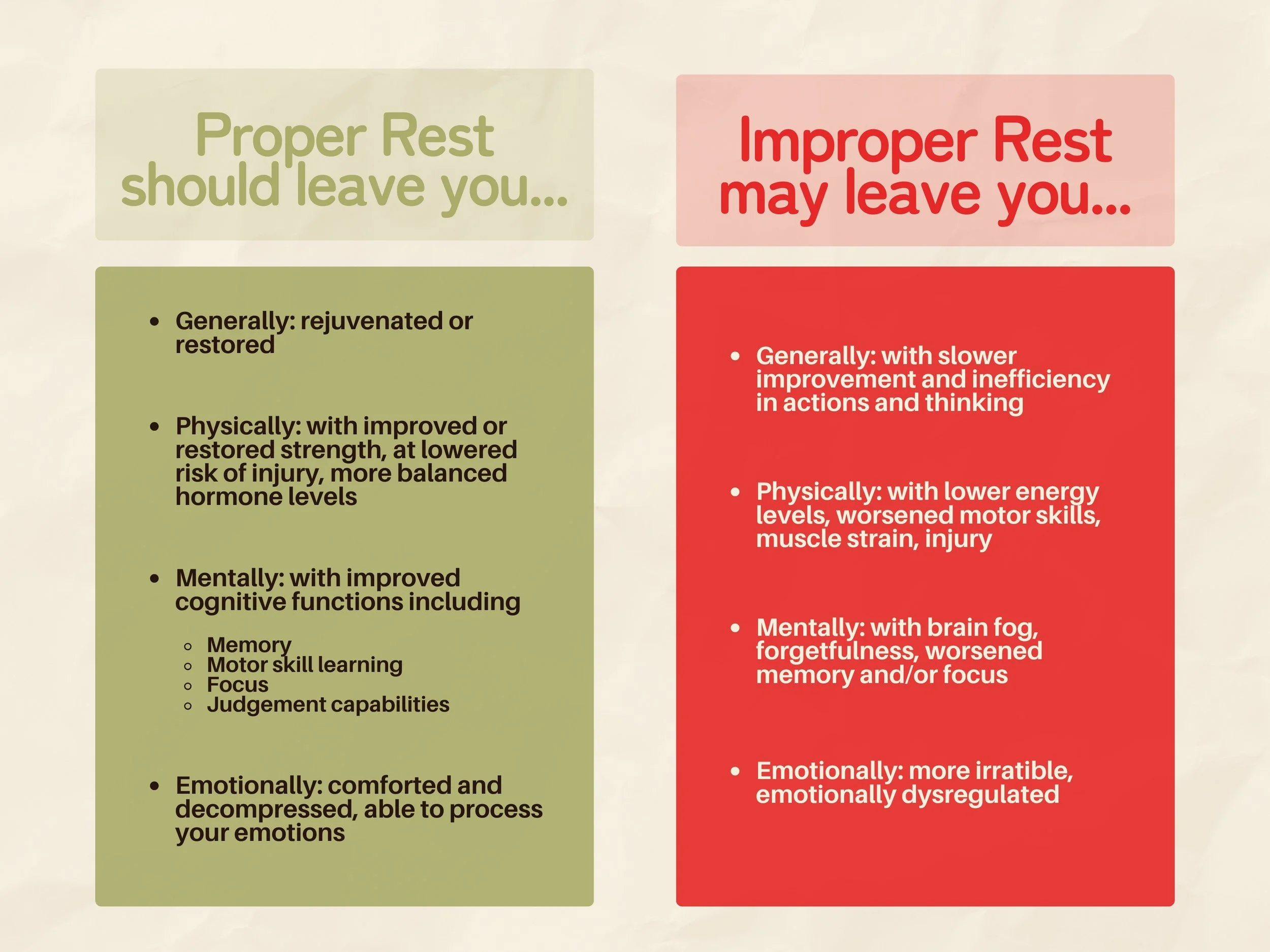
Here is a very generalized list of benefits of proper rest and their counterpart consequences of improper rest. Click here to download the chart to keep for yourself as a reminder!Rest in a Musician’s Routine
Typical activities for an elite runner may include a run in the morning, a balanced breakfast, an ice bath, stretching, analyzing form, a run before bed, and ankle rolls for 10 minutes before bed. Notice that only two of those seven activities are running. The others are activities that, when done consistently, will help maintain a healthy and balanced approach to running and lead to more improvement over time.
Musicians should have a similar approach to their music-making and daily regime. Our routines may look like stretching, warming up, practicing, listening to past performances or practice sessions, practicing more, and reflecting in a journal at the end of the day. Too often we get so focused on how much time we’re spending in the practice room so we disregard the other activities that will ultimately help make us more well-rounded musicians and experience more growth.
Here is a list of alternative practice techniques and recovery activities based on anecdotal evidence and how athletes use rest and recovery to improve their performance. The idea of these strategies is that they are still focused on performance repertoire for the days when you do not have time to practice as much as you’d like, don’t have an instrument, or may be recovering from an injury but still want to progress. These non-playing practice strategies are just a glimpse at the possibilities of rest in a musician’s routine. Music-oriented rest may look like:
Score study
Listening to past performances and reflecting on them mentally or in writing
Listening to several recordings of your repertoire by different artists
Learning about the history of your pieces
Going to performances
Observing rehearsals, lessons, or practice sessions of other musicians
Using strategies that focus on your repertoire without your instrument help develop a more holistic understanding of the music itself, as well as contribute to the development of valuable skills that can be applied to areas outside of performing. For example, listening to and reflecting on old performances in a notebook helps to improve your skills giving written feedback and constructive criticism while also helping you notice and understand your nervous performance habits. Score study can help you gain a more comprehensive understanding of music theory while specifically improving your idea of the piece and potentially informing future performance decisions.
Strategies such as these, allow a break from the dark, tiny practice room (thus creating a better balance between time spent in and out of the practice room) and provide variety into a practice routine. Keeping things fresh like this can help maintain a healthy relationship with the practice room and your instrument.
Additional Reading and Material
The Art of Rest by Claudia Hammond (Book)
⚘ ⚘ ⚘
Incorporate rest into your practice routine with this 10-minute meditation led by Jenny Magic. 
Incorporate rest into your daily routine with these non-playing practice strategies. Click here to download.⚘ ⚘ ⚘
“Rest is a form of self-care that decreases tension”
—Natalie Dattilo-RyanReferences
Asp M. (2015). Rest: A Health-Related Phenomenon and Concept in Caring Science. Global qualitative nursing research, 2. https://doi.org/10.1177/2333393615583663Abramson, A. (2025, May 6). Seven types of rest to help restore your body’s energy. https://www.apa.org/topics/mental-health/seven-rest-typesBernhofer E. I. (2016). Investigating the concept of rest for research and practice. Journal of advanced nursing, 72(5), 1012–1022. Eccles, D. W., Balk, Y., Gretton, T. W., & Harris, N. (2022). “The forgotten session”: Advancing research and practice concerning the psychology of rest in athletes. Journal of Applied Sport Psychology, 34(1), 3–24. https://doi.org/10.1080/10413200.2020.1756526https://doi.org/10.1111/jan.12910Eccles, D. W., Balk, Y., Gretton, T. W., & Harris, N. (2022). “The forgotten session”: Advancing research and practice concerning the psychology of rest in athletes. Journal of Applied Sport Psychology, 34(1), 3–24. https://doi.org/10.1080/10413200.2020.1756526Scripter, L. (2025). Meaningful rest. Journal of Applied Philosophy, 42(3), 1016–1038. https://doi.org/10.1111/japp.70003*This article reflects a Western—particularly American—perspective on rest, where cultural values around productivity and achievement often influence how rest is defined and practiced. It’s important to recognize that rest holds different meanings and connotations across cultures, and this is only one lens through which to explore it.