
Healthy Musicianship:
What is it Anyway?
Why it’s important and how research on wellness can translate to music!
Feel free to start where you need
What is
Healthy Musicianship?
A common term that is used in music education is that of “musicianship.” This idea broadly refers to the skills, knowledge, and capabilities required for one to practice, perform, or appreciate music effectively.
Healthy musicianship furthers this definition by emphasizing the importance of understanding, maintaining, and prioritizing healthy physical, mental, and emotional relationships with music and music-making. It may also look like the intentional fostering of environments where healthy actions and relationships can occur naturally, and are encouraged and celebrated, since music-making is rarely an individual endeavor.
Healthy musicianship is an approach to music-making that considers your health and wellness as necessary tools for effective music-making. Since our bodies and minds are vessels for the musical skills we learn and perform, when they are not well, the music eventually suffers. Deprioritizing physical health may lead to lower stamina or higher risk of injury. Deprioritizing mental and emotional health may lead to frustration, imposter syndrome, worsened mental health conditions, or burnout.
In an ideal world, the skills specific to healthy musicianship would be naturally included with the broad concept of musicianship and would not require its own description. However, for too long musicians have largely prioritized effective music-making over their personal well-being and the inclusion of health as a tool within musicianship has not been a frequent topic of conversation. The effects of this are clear when we look at research regarding musician’s job satisfaction as well as their personal health and well-being (more on that in this post).
Definitions
Musicianship: the skills, knowledge, and capabilities required for one to practice, perform, or appreciate music effectively
Healthy Musicianship: understanding, maintaining, and prioritizing healthy physical, mental, and emotional relationships with music and music-making; fostering environments where healthy actions and relationships can occur naturally, and are encouraged and celebrated
Wellness: the active pursuit of activities, choices and lifestyles that lead to a holistic state of health
Well-being: a broad concept that encompasses a subjective state, making a definition difficult to pin down. Here are a few different definitions to get an idea of what well-being may encompass:
“The state of being happy, healthy, or prosperous”
“A positive state experienced by individuals and societies [that] encompasses quality of life and the ability of people and societies to contribute to the world with a sense of meaning and purpose.”
“How people feel and how they function both on a personal and social level, and how they evaluate their lives as a whole.”
About the Research
As personal health and well-being has become a more common topic in everyday conversations, the research and information around it has skyrocketed [SEE chart below]. Due to the subjectivity of the topic, definitions and usage vary wildly from discipline to discipline and person to person. Do not let this deter you though! The subjectivity of the topic is what makes it so interesting to explore and should encourage greater curiosity and a wider range of ideas for you to draw from.
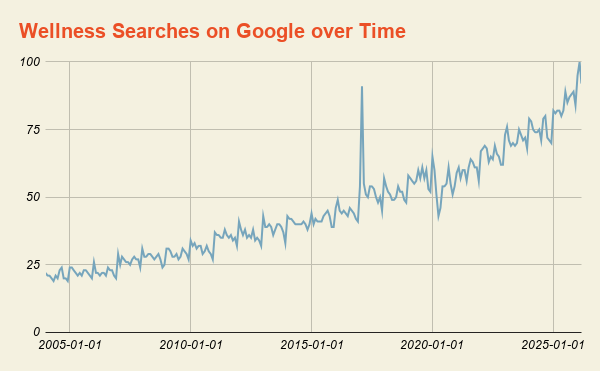
Data source: Google Trends (https://www.google.com/trends) Accessed March 24, 2026Some areas of research where the information can (often) be translated easily to music:
Performance psychology focuses on what happens when you perform tasks and how to optimize performance. A large portion of the research is focused around athletic performance but can often can be translated easily to music performance. Luckily for us musicians, more research on music-specific performance is emerging!
Cognitive psychology focuses on the science of learning and how cognitive processes can occur efficiently and effectively, as well as how cognitive processes affect experience and knowledge.
Positive psychologyis a newer field of psychology that focuses on the conditions and processes that contribute to wellbeing, fulfillment, hope, and general happiness. You can read more specifically about how this field can be translated to music education here.
Additional Reading and Material
Understanding Wellbeing: An Introduction for Students and Practitioners of Health and Social Care edited by Anneyce Knight and Allan McNaught (Book)
The Musician’s Way by Gerald Klickstein (Book and Website)
⚘ ⚘ ⚘
“If we want to prepare [musicians] for lifelong music making, we have to ensure that they remain healthy to do so.”
—Kathleen A. Horvath“Musicians must recognize that part of the price of admission to a life of music performance is engaging in the necessary practices of healthy living.”
—William J. DawsonReferences
Dawson, W. J. (2016). Empowering Musicians: Teaching, Transforming, Living: Arts-Medicine Mailbox: Dr. Dawson Answers Your Questions. American Music Teacher, 66(2), 35–37. https://www.jstor.org/stable/26385743Jarden, A., & Roache, A. (2023). What Is Wellbeing? International Journal of Environmental Research and Public Health, 20(6), 5006. https://doi.org/10.3390/ijerph20065006McNaught, A. (2011). Defining wellbeing. Understanding wellbeing: An introduction for students and practitioners of health and social care, 7-23.Horvath, Kathleen A. (2008). Adopting a Healthy Approach to Instrumental Music Making. Music Educators Journal, 94(3), 30–34. http://www.jstor.org/stable/4623688